Twelve U.S. Air Force F-22 Raptor fighter jets landed at an Israel Air Force base Tuesday evening, marking a significant escalation in the American military presence in the Middle East amid rising tensions with Iran.
The F-22, widely regarded as the world’s most advanced air superiority fighter, is operated exclusively by the United States. Though production ended in 2011, the aircraft remains highly classified, and the U.S. Department of Defense has never approved it for foreign sale. Built jointly by Lockheed Martin and Boeing, the twin-engine stealth jet is designed primarily for air dominance but is also capable of ground attack and electronic warfare missions.
The Raptors’ arrival comes as Washington continues to reinforce its regional posture ahead of a new round of nuclear negotiations with Tehran scheduled for Thursday in Geneva. Open-source intelligence assessments and publicly available flight tracking data suggest more than 300 U.S. military aircraft are currently deployed across the broader Middle East.
In addition to the F-22s, the U.S. has positioned major naval assets in the region, including the USS Gerald R. Ford, the world’s largest aircraft carrier, now operating in the eastern Mediterranean.
The buildup signals that Washington and Jerusalem are preparing for multiple contingencies as diplomacy with Iran proceeds under mounting strain.
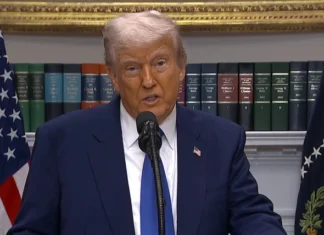
“We are in negotiations with them,” President Donald Trump said during his State of the Union address Tuesday. “They want to make a deal, but we haven’t heard those secret words: ‘We will never have a nuclear weapon.’”
Trump reiterated that while he prefers a diplomatic solution, preventing Iran from acquiring a nuclear weapon remains non-negotiable.
“My preference is to solve this problem through diplomacy,” he said. “But one thing is certain, I will never allow the world’s No. 1 sponsor of terror … to have a nuclear weapon.”
During the address, Trump referenced Operation Midnight Hammer, a June strike in which U.S. B-2 stealth bombers, supported by F-22s and F-35s, targeted Iranian nuclear facilities. While the B-2 bombers drew the most public attention, Trump later confirmed that F-22s played a critical supporting role in the operation, even though their missions were not publicly detected at the time.