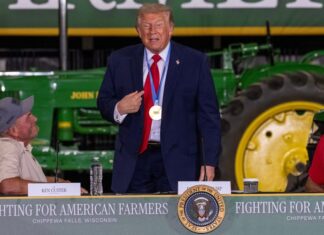
Katie Pavlich’s new program on NewsNation is already making waves after launching Monday with an interview featuring YouTuber Nick Shirley, whose reporting brought renewed attention to widespread Somali-led fraud in Minneapolis. The show followed up that debut with a lengthy sit-down interview with President Donald J. Trump, part one of which aired last night, with part two scheduled for tonight. The interview ranged across domestic unrest, national security, and foreign policy, offering a snapshot of how the administration is framing several rapidly escalating issues.
Katie Pavlich just asked President Trump about the Insurrection Act and whether he’d use it in Minnesota.
His answer left no room for doubt about his willingness to act if necessary.
PAVLICH: “The Insurrection Act would allow you — requires essentially that if federal law… pic.twitter.com/G0Wd2rVOMN
— Overton (@overton_news) January 21, 2026
A major focus of the conversation was the ongoing turmoil in Minneapolis following the shooting death of Renee Nicole Good, a left-wing activist known for disrupting ICE operations. Good was fatally shot by a federal officer after video evidence showed her ramming her vehicle into him. Despite the footage, claims quickly spread through activist circles that the incident was a murder, a narrative that has fueled unrest across the city. Since then, reports have emerged of innocent civilians being harassed and accused of being ICE agents, churches being invaded and disrupted, and property damage including vandalized hotels. The situation has increasingly taken on the character of a riot rather than a contained protest.
Trump calls on Congress to codify his executive orders ahead of the midterm pic.twitter.com/BMabgSHrbs
— Jorge Bonilla (@BonillaJL) January 21, 2026
In response to the instability, the Trump administration has reportedly mobilized approximately 1,500 troops, positioning them in the event that the Insurrection Act is invoked. During the interview, Pavlich pressed the president on whether that step was imminent. Trump said he does not believe it is necessary at this time but emphasized that he would not hesitate to use the authority if federal law can no longer be enforced. He noted that the Insurrection Act has been used by a significant number of presidents throughout American history, framing it as a normalized, if serious, executive tool rather than an extraordinary measure.
.@POTUS on Minnesota: “Number one, you have $19B worth of stolen money…and then you have the agitators, anarchists…these are professional, paid people…What they don’t see is that ICE gets rid of murderers, drug dealers, Tren de Aragua—the worst gang anywhere in the world.” pic.twitter.com/iS7I4zWyqP
— Rapid Response 47 (@RapidResponse47) January 21, 2026
Beyond Minneapolis, Trump addressed broader priorities, including his push to secure U.S. control over Greenland, which he again framed in terms of national security. He also reiterated his desire to see his executive orders codified into law before the 2026 midterm elections, signaling concern about the durability of policy achieved solely through executive action. Domestically, Trump issued a warning to Virginia Governor Abigail Spanberger against pursuing aggressive left-wing policies, while also offering characteristically sharp remarks about what he described as Democratic fixation on his presidency.
President Trump warned Tuesday that the U.S. would respond forcefully if Iran acts on alleged assassination threats against him. Speaking exclusively with NewsNation’s @KatiePavlich, Trump said, “Anything ever happens, the whole country is going to get blown up.” @KatiePavlichNN… pic.twitter.com/JA5YeHc2RE
— NewsNation (@NewsNation) January 21, 2026
On the international front, Trump delivered stark warnings to Iran’s leadership amid reports that tens of thousands of protesters have been killed during ongoing unrest. He indicated that continued violent repression would provoke a severe response from the United States, underscoring that his administration views the situation not only as a human rights crisis but as a matter with broader regional implications.