While President Donald Trump and thousands of supporters gathered to celebrate America’s 250th anniversary with UFC Freedom 250 on the White House grounds, a very different event was unfolding across the country. In fact, it wasn’t just one event. It was an entire network of protests, concerts, watch parties, and activist gatherings organized by a coalition determined to make sure Trump wasn’t the only one commanding attention that day.
And if you look closely at what happened, it’s clear this wasn’t simply a one-day protest. It was a political organizing operation disguised as a series of community events.
According to internal planning documents obtained by Fox News Digital, roughly 400 organizations operating under the “No Kings” banner coordinated activities stretching from New York City to Washington, D.C., and beyond. Collectively, those organizations represent billions of dollars in annual revenue and thousands of activists nationwide.
The public face of the effort was easy to spot.
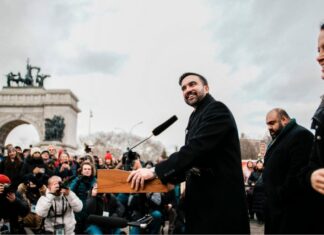
There were demonstrations with names like “RAGE AGAINST THE CAGE!” near the White House. The Women’s March organized a protest called “Dump on Trump” just blocks away. UFC fighter Sean Strickland even announced plans to appear at one of the protests after claiming he had been removed from the White House fight card because of his political views.
But the real story wasn’t what happened on the streets. It was what organizers hoped would happen afterward.
Buried inside a 16-page organizer toolkit was a much broader objective. The coalition repeatedly described the day’s events as an opportunity to build local political infrastructure and recruit activists who could remain engaged through future elections.
The language wasn’t subtle.
Watch parties were described as “strategic community gatherings” designed to create grassroots networks. Hosts were instructed to gather contact information, identify future leaders, recruit volunteers, and schedule follow-up meetings. One guide explicitly told organizers to determine who could help with future organizing efforts and to establish another meeting within two weeks.
In other words, the protests were only the beginning.
The coalition’s messaging made that clear as well.
One suggested talking point stated, “He wants attention. We’re building a movement.”
Another contrasted the White House UFC event with the coalition’s own activities by declaring, “The main event will be in our living rooms.”
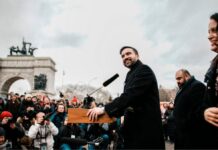
The most visible component of the effort took place in New York City, where actress Jane Fonda’s Committee for the First Amendment hosted a concert called “Rise Up, Sing Out.” The event featured a lineup that included Fonda, Patti Smith, Bette Midler, Joy Reid, Wilson Cruz, and other prominent left-leaning figures.
Organizers described the concert as a celebration of free speech, free press, religious liberty, and the right to protest. Critics saw something else: a celebrity-driven political rally wrapped in the language of civic engagement.
Fonda’s involvement drew particular attention. Decades after her controversial Vietnam War-era trip to North Vietnam earned her the nickname “Hanoi Jane,” she remains one of the most polarizing figures on the American left. Her participation ensured the event would attract headlines, but it also guaranteed criticism from conservatives who view her activism through a very different lens.
What makes the entire operation noteworthy is the degree of organization behind it.
This wasn’t a spontaneous protest movement. Internal documents reveal reimbursement programs, communications strategies, volunteer structures, media outreach plans, safety protocols, and strict message discipline. Organizers repeatedly emphasized nonviolence, requiring every approved event to include mandatory nonviolence language.
At the same time, the coalition found itself walking a delicate line. While organizers insisted that events could not engage in lobbying, endorse candidates, or formally coordinate with political parties, much of the messaging centered squarely on opposition to Trump and preparation for future political battles.
That contradiction was not lost on critics.
Supporters argued they were defending democracy and civic participation. Opponents saw a highly partisan operation attempting to present itself as nonpartisan while clearly targeting one political figure and one political movement.
As the day concluded, both sides claimed victory.
Trump supporters celebrated a uniquely American spectacle on the White House lawn complete with UFC fighters, patriotic themes, and America 250 festivities. Meanwhile, organizers behind the “No Kings” effort pointed to turnout numbers, new recruits, and expanded activist networks as evidence that their movement was gaining momentum.