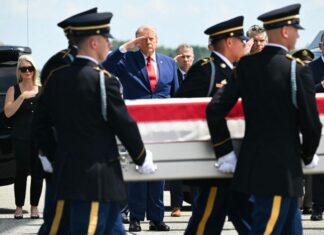
There are military ceremonies, and then there are moments that remind you why certain medals exist in the first place.
The White House became the setting for one of those moments as President Donald Trump awarded the Medal of Honor—the nation’s highest military decoration—to three American warriors whose acts of courage spanned decades and battlefields, from the jungles of Vietnam to the mountains of Afghanistan.
At the center of the ceremony was 88-year-old Marine veteran Major James Capers Jr., a man many believe should have received the honor nearly sixty years ago.
The scene was powerful from the start. Trump personally assisted Capers as he made his way to the stage, helping the aging Marine approach the podium where he would finally receive the recognition that had eluded him for generations.
And what a story it is.
Back in Vietnam, Capers led a nine-man reconnaissance team deep into enemy territory on a dangerous mission that quickly turned into a nightmare. His team was ambushed by North Vietnamese forces, triggering a brutal fight for survival.
Most men would have been out of the fight after suffering even a fraction of what Capers endured. He was shot twice. He absorbed 17 shrapnel wounds. Yet somehow he kept fighting, kept leading, and most importantly, kept his men alive.
Then came the helicopter extraction.
As the overloaded aircraft struggled to lift off, Capers reportedly tried to remove himself from the helicopter so the rest of his team could escape. Think about that for a second. The man had already been shot twice and torn apart by shrapnel, and his instinct was still to sacrifice himself for his fellow Marines.
Fortunately, they refused to let him do it.
Trump reflected on the ordeal during the ceremony.
“I hope this isn’t giving you some bad memories, Jim, but I’ll tell you, everybody admires what you went through, believe me,” the president said.
Trump also explained why the award took so long.
Capers had been recommended for the Medal of Honor in 1967, but his commanding officer was killed before the paperwork could be completed.
“That’s a bad break, but now you’re doing it,” Trump said. “The nation kept you waiting far too long.”
The ceremony then turned to another legendary Marine, Colonel John Ripley.
Military history buffs already know the story. During the Vietnam War, Ripley became famous for an act that sounds more like something from a war movie than real life.
With North Vietnamese forces advancing, Ripley repeatedly climbed beneath a bridge while under enemy fire, carrying hundreds of pounds of explosives. Suspended above rushing water and completely exposed to hostile troops, he made trip after trip until enough explosives had been placed to destroy the structure.
The resulting explosion stopped the enemy advance.
Trump painted the picture vividly.
“Dangling beneath the bridge and over the rushing water, with a lot of very angry people watching him, completely exposed to withering enemy gunfire, John completed, not one, not two, but five such trips.”
Ripley passed away in 2008 before receiving the Medal of Honor. After Congress authorized the award earlier this year, his family accepted it on his behalf.
In classic Trump fashion, the president added a lighthearted remark.
“Congratulations, you have extremely good genetics,” he told Ripley’s relatives.
The final recipient brought the ceremony into the modern era of warfare.
Retired Army Major Nicholas Dockery was recognized for extraordinary heroism during combat operations in Afghanistan in 2012.
Dockery’s platoon found itself facing what soldiers dread most: overwhelming odds. Roughly 150 Taliban fighters launched a coordinated ambush, attacking from multiple directions with machine guns and rocket-propelled grenades.
The battlefield quickly became chaos.
Instead of seeking cover, Dockery repeatedly exposed himself to enemy fire to rally his scattered troops and evacuate wounded soldiers.
“They were ambushed by 150 Taliban fighters swarming in from multiple directions,” Trump said. “The enemy unleashed overwhelming torrents of fire from machine guns and rocket-propelled grenades.”
Despite the danger, Dockery continued moving across open ground to organize the defense and rescue his men.
“Without concern for his own life at all, Nick raced across the open ground to rally his scattered team,” Trump said.
Then came perhaps the most fitting line of the day.
“Major Dockery, you were the last man to depart the battlefield that day, and you left it a legend and a hero.”
The Medal of Honor exists for acts that go beyond courage, beyond duty, and beyond ordinary human instinct. Looking at the stories of James Capers, John Ripley, and Nicholas Dockery, it’s easy to understand why their names now join that exclusive list.
Different wars. Different generations. Different battlefields.
The same extraordinary willingness to risk everything for others. And on Thursday, the nation finally paused to recognize it.